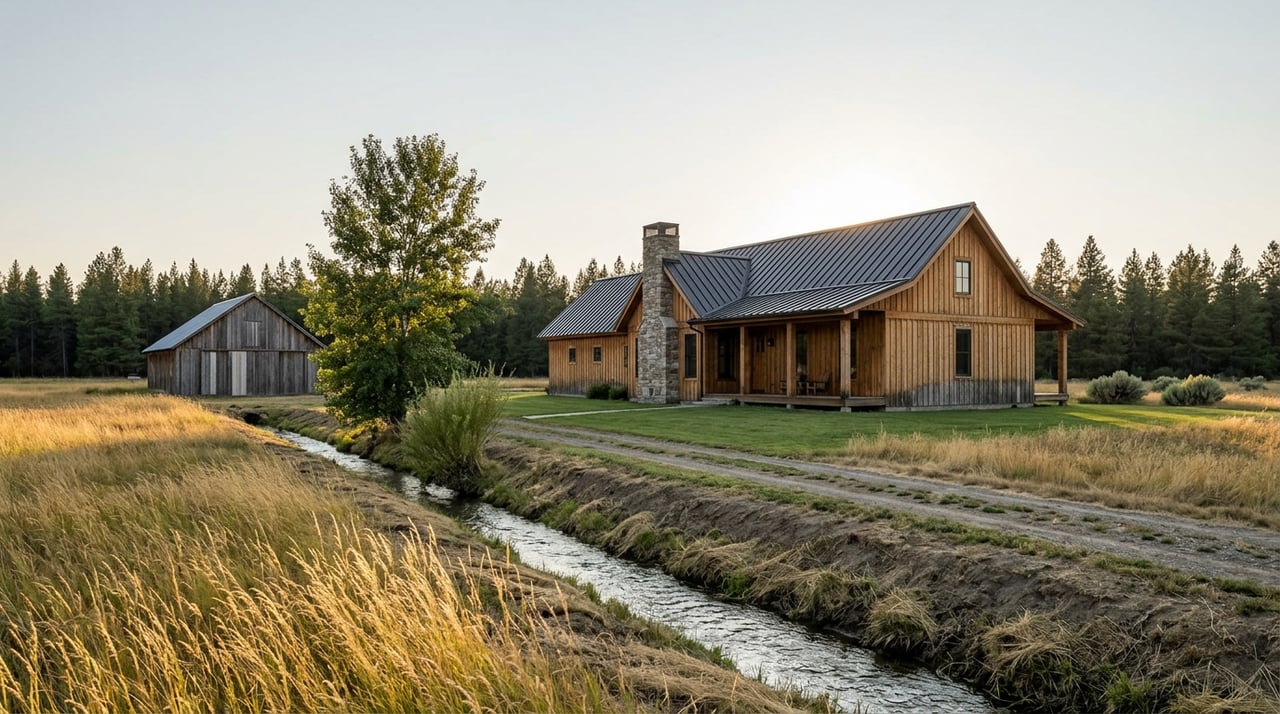
When Turner Resor talked to the Jackson Hole News&Guide about selling two new conservation easements on his family's Snake River Ranch, he described the arrangement as
"a great opportunity to get some money to the family without having to develop more"
It's an odd sentence to sit with if you're shopping for acreage south of Jackson. Selling an easement, in the popular imagination, is what a family does instead of developing. But Resor's version has a third option built in: conservation and continued ranching, side by side, on land that keeps working. That third option is exactly what gets lost when a listing reduces a property's legal history to two words, "conservation easement," as if the phrase alone settles what you can and cannot do with the ground.
It doesn't. South of Jackson, where working ranches, protected wildlife corridors, and buildable home sites often sit on the same parcel map, the gap between what a conservation easement sounds like and what it actually permits is the first place a transaction gets complicated. The second is water. Both blind spots surface late, usually after a buyer has already fallen for the view.
The Percentage Everyone Quotes, and the Question It Doesn't Answer
A few years ago, a 233-acre ranch elsewhere in Jackson Hole came to market with a detail meant to signal exclusivity: 96 percent of the land sat under conservation easement. Read quickly, that number sounds like a ceiling. Read closely, it's the opposite of a limit on three of the property's six parcels.
The ranch was split into six parcels ranging from 3 to 127 acres. Three of them, the ones closest to the road, retained full building entitlement. One was vacant land ready to build on. Another already held a 4,800-square-foot farmhouse-style home and a 2,000-square-foot barn. A third carried a 2,070-square-foot log cabin. The conservation easement covering the bulk of the acreage did real work protecting habitat and views, and it did not touch the building rights attached to those three parcels at all.
That's the pattern to watch for south of Jackson. A conservation easement is negotiated parcel by parcel and clause by clause between a landowner and a land trust, not applied as a blanket percentage across an entire ranch. The number in the listing tells you how much ground is protected. It tells you nothing about which parcel you're actually buying or what that parcel's specific easement deed reserves for building. Only the recorded deed answers that question, and it's worth reading in full before you write an offer, not after.
The Same Pattern, Playing Out on Snake River Ranch Right Now
This isn't a one-time quirk of a single listing. It's how conservation works on the ranches that make up much of the land south of Jackson.
The Snake River Ranch, the largest deeded ranch in the Jackson Hole area, has been layering conservation easements onto its acreage since the 1980s while continuing to graze cattle and cut hay the entire time. In 2023, the Resor, Hauge, and Laughlin families recorded two new easements protecting roughly 250 acres near Fall Creek Road for about $7 million in combined state and federal funding, aimed at preserving an elk migration corridor between the state's South Park feedgrounds and the Snake River Range. A year later, the Jackson Hole Land Trust and the Conservation Fund announced a second round on the same ranch: the Chimney Draw Corridor I and II easements, covering 256.5 acres at the foot of the Snake River Range near Munger Mountain.
JHLT president Max Ludington described the goal as work that would "expand the mosaic of conserved public and private lands along the base of Munger Mountain." Read the deals together and a pattern emerges: each easement protects specific acreage for specific reasons, migration corridors, riparian buffers, scenic ridgelines, while leaving the working core of the ranch, its grazing and hay ground, its homesites, untouched. The family isn't giving up the ranch. They're selling the development rights on the parts that matter most for wildlife and keeping the rest.
For a buyer, the takeaway isn't that conservation easements are good or bad for value. It's that the label doesn't travel with the whole property the way a zoning designation does. Every parcel needs its own answer.
Public Land Next Door Isn't the Same Question, But It Shapes the Answer
South of Jackson buyers often end up next to public or state trust land, and that adjacency has its own recent history worth knowing. A 640-acre state trust parcel on Munger Mountain spent years as the subject of a proposed Under Canvas glamping development, an idea that a resident group called Friends of Munger Mountain organized against. In August 2024, Wyoming's Board of Land Commissioners voted unanimously to approve a different path: a 35-year recreation lease costing Teton County $2.6 million plus an inflation adjustment, under which the county, Friends of Pathways, and Teton County Weed and Pest maintain trails and keep the parcel undeveloped for hiking, biking, and hunting.
That resolution doesn't change what you can build on your own land. It does mean that a neighboring 640 acres that could have become a commercial glamping operation is now locked into recreational use for decades. If a listing's view or privacy pitch depends on what sits next door staying undeveloped, this is the kind of public record that's worth confirming rather than assuming.
The Blind Spot Title Insurance Doesn't Cover
Conservation easements at least show up in the county's title records. Water rights often don't, and that's the second gap that trips up buyers south of Jackson, where irrigated pasture, hay meadows, and stock ponds are part of what makes a ranch parcel function.
Wyoming title companies search the Teton County Clerk's land records for liens, easements, and encumbrances tied to a property. Water rights are a separate legal category entirely, documented through the Wyoming State Engineer's Office using permits, priority dates, and adjudicated certificates tied to a legal description built on section, township, and range, not a street address. A title company's clean report says nothing about whether the water rights attached to a parcel are real, current, or adequate for irrigation. Standard purchase contract language typically states that any water rights the seller owns will transfer with the sale. That sentence is boilerplate. It confirms a transfer happens. It says nothing about what's actually being transferred, because a seller might hold decades of high-priority irrigation rights covering hundreds of acres, or nothing beyond a domestic well permit. The contract reads identically either way.
Ditch access compounds the problem. Wyoming has no water statute governing ditch easements at all. The right to maintain a ditch is a matter of common law, and a ditch owner has an inherent right to enter land within a reasonable distance on either side of the ditch to clean and repair it, whether or not a written easement was ever recorded. In some cases these rights exist only by ten years of unwritten use, a prescriptive easement that predates the current owner's deed and survives the sale regardless. A buyer who assumes a ditch crossing their new pasture is decorative, rather than a working piece of someone else's irrigation infrastructure, can find equipment on the property line without warning.
What to Actually Ask Before You're Under Contract
South of Jackson's ranch and acreage market rewards buyers who ask sharper questions earlier. Before an offer goes in on a property with any conservation easement or irrigation history, it's worth confirming:
- Which specific parcel are you buying, and does its recorded easement deed reserve building rights, or does the deed apply to the entire tract as one unit
- What does the easement holder, typically a land trust or the Wyoming Game and Fish Department, list as permitted improvements: barns, guest houses, additional homesites
- Has the seller run a State Engineer's Office search by legal description to confirm the water rights attached to the land, rather than relying on contract boilerplate
- Is there a recorded ditch easement, and if not, has the seller experienced any ditch company access, maintenance disputes, or seepage issues in their ownership
- Is the road access to the property established by a recorded easement, particularly if the parcel borders Bridger-Teton National Forest or other federal land
A Teton County real estate attorney and a qualified water rights researcher earn their fee here. So does an agent who has actually read the deeds on ranches like these rather than repeating what the listing sheet says.
A Few Questions Worth Settling Early
Does a conservation easement always lower a property's resale value? Not necessarily. Buyers in this market often pay a premium for the privacy and protected views an easement guarantees will never change next door. The value question depends entirely on whether the parcel you're purchasing retains the building rights you want.
How do I actually verify water rights before closing? Ask for the property's legal description in section, township, and range format, then request a search through the Wyoming State Engineer's Office records rather than relying on the title commitment, which does not cover water rights at all.
What if there's an old irrigation ditch on the property with no recorded easement? Assume it may still carry a legal right of access under Wyoming common law or a prescriptive easement built on ten years of prior use, and confirm with the seller and, if needed, a title attorney before you build anything near it.
South of Jackson rewards buyers who read the fine print the way the sellers already have. If you're evaluating acreage, a working ranch, or a homesite anywhere between Jackson and the Snake River Bridge, Jake Kilgrow can walk the parcel boundaries with you, pull the actual easement language, and make sure the land you close on is the land you thought you bought.